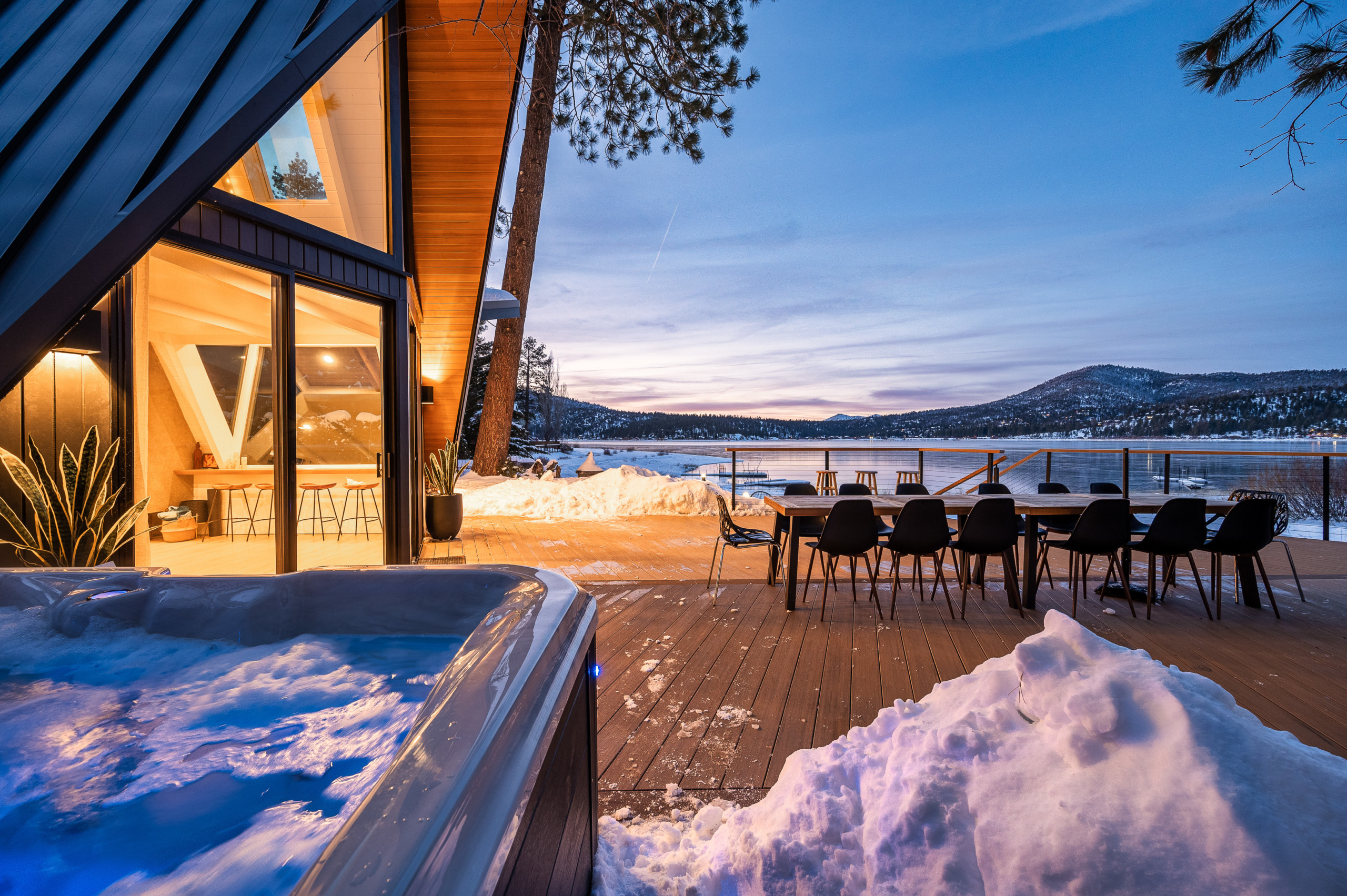
Beyond the Cabin: What Every Lakefront Buyer in Big Bear Should Evaluate First
Lakefront in Big Bear is about more than the cabin. Holly Gardner explains what to evaluate first: water levels, shoreline, docks, sun exposure, and how the lake really works for your family.
Most lakefront buyers in Big Bear fall in love with the cabin before they ever really look at the lake. The deck, the firelight, the big windows over the water, it is easy to let the house do all the talking. But in a lifetime on this mountain, Holly Gardner, a Certified Big Bear Resort Property Specialist, has learned that the parcel beside that house matters just as much, and sometimes more. Before you commit to a Big Bear lakefront property, here is what to evaluate beyond the front door, so the home you buy matches the water you actually get to enjoy.
The blind spot: you are buying a piece of the lake
Here is the honest truth about Big Bear lakefront: no two waterfront parcels behave alike, even when the houses on them look similar. The lake runs about seven miles long with roughly twenty-two miles of shoreline, and it is not one uniform body of water. It is a collection of very different micro-environments. A calm, sheltered cove on the quiet north shore can feel like a private swimming hole on a July afternoon, while a parcel on a high-exposure stretch of open water catches every wind that crosses the basin. The same house on those two parcels would give you two completely different lives.
Most buyers evaluate only what they can see from the driveway: the condition of the home, the size of the lot, the way the light hits the great room. The water, though, is where the real personality, and the real risk, lives. Which way does the wind sweep through? Is the shoreline sandy, rocky, or a steep granite ledge? Does the water in front of the dock get deep quickly, or does it stay shallow for a long way out? Those are the questions that decide whether your lakefront home is a place you use every day, or a view you mostly admire through the glass.
Water levels move, and that changes everything
Big Bear Lake is not a still pond. It is a snowmelt-fed reservoir sitting at about 6,700 feet, and its surface rises and falls with the weather. Locals track the level in feet below full, and that number swings a lot from year to year. In dry years the water has sat more than a dozen feet below full pool; after a big snow winter it climbs back up. Anyone who has lived here long remembers the years when the beach widened far out into what used to be open water, and the winters when the lake came right back to the shoreline.
For a lakefront buyer, that fluctuation is not trivia. It is the single most important fact about your parcel. A dock and a boat need a certain baseline water depth at the end of the pier, and if that depth only exists in wet years, your dock season becomes a recurring negotiation with the lake level. Ask how the parcel sits relative to the historical low. Does the water stay deep enough for your vessel even when the lake drops, or does your shoreline turn into a long, dry shelf in drought years? The Big Bear Municipal Water District manages the lake, and it is worth understanding where the water has been before you buy a home that assumes it will always look exactly the way it does on the day you tour it.
Docks, shoreline access, and the sun
Here is something that surprises almost every out-of-town buyer: in Big Bear you do not simply buy a dock with the house the way you might assume. The district manages the lakebed, and dock privileges are tied to your shoreline frontage. A property with very little frontage generally has no dock privileges at all, a mid-range frontage typically qualifies for a single-slip dock, and wider frontage can qualify for more. Whether those privileges actually transfer when you buy, and whether the existing dock on the property is properly permitted, has to be verified before you commit. A listing that looks like a boater's dream on paper can come with a dock situation you cannot count on.
Shoreline accessibility matters just as much as the dock itself. Is there a real path from the house down to the water, and can you actually carry a kayak or paddleboard down it? On some Big Bear parcels the water is right there. On others a rocky bank or a steep drop makes access harder than it looks from the living room. And do not underestimate the sun. Lakefront exposure decides which hours you get morning light on the deck, how warm the water-side rooms run by afternoon, and how much of your shoreline stays in shade, and in snow, in winter. A sun-facing parcel can feel like a completely different property from a shaded one, even on the same shoreline.
Match the water to how you will really use it
The best lakefront buy in Big Bear is not the one with the prettiest view. It is the one that fits the life you actually want to live on the water. Start with your lake personality and work backward to the parcel.
- If you are a boater, you need water that stays deep enough at your dock across seasons, plus the slip privileges to go with it. Shallow, sheltered shallows that are lovely to swim in can be a headache for a boat.
- If you are a fisherman, shoreline and bottom structure matter. Different parts of the lake offer very different fishing, and where the fish hold is not the same everywhere.
- If you are a swimmer, a sheltered, gradually sloping shore with sand or smooth rock beats a steep rocky drop, and you will want to know exactly what the water feels like on a summer afternoon.
- If your summers are for kayaking and paddleboarding, calm, sheltered coves and easy water access are worth more than open-water exposure.
- And if you come for winter, think about how the shoreline and the approach sit under snow, and how the property handles the freeze when the dock comes out.
There is no universally best parcel, only the parcel that is best for your kind of lake life. Holly has watched buyers settle for years in the wrong spot because they bought the prettiest view instead of the most usable water.
The takeaway: buy the water along with the house
Treating a lakefront property like a standard residential purchase is the most common, and the most expensive, mistake Holly sees. A buyer can evaluate cabinets, flooring, and square footage perfectly and still miss what really determines long-term value and enjoyment: how the water behaves at that exact spot on that exact shoreline. Here, value is shaped by lake level history, dock privileges, shoreline access, and sun, the environmental factors no interior remodel can fix.
The good news is that none of this is a mystery to someone who grew up here. Holly is a lifelong Big Bear resident, has spent 20+ years in mountain real estate, and has lived through the lake's ups and downs her whole life. She can look at a parcel and tell you what the water does in a dry summer, what the dock situation really allows, and whether the shoreline will work for your family. That is the value of working with a Big Bear native, not just a licensed agent.
Thinking about Big Bear lakefront?
Bring your questions about lakefront properties in Big Bear. Whether you are just starting to dream or ready to write an offer, Holly would love to talk through the water, the shoreline, and the dock situation before you commit. Call or text her at (909) 261-2486, or send a message through the contact page.
Sources & further reading
- Big Bear Municipal Water District, Current Lake Stats
- Big Bear Municipal Water District, Residential Docks
- Big Bear Map, Lake Facts: Depth, Elevation & Water Quality
- City of Big Bear Lake, Lake Management
Lake level and shoreline details are general, publicly reported facts about Big Bear Lake as of 2026 and change over time. Verify current conditions and dock privileges for any specific property with the district before you buy.
Ready to talk Big Bear real estate?
Whether you are buying, selling, or investing, Holly would love to hear your story. No pressure, just straight answers.